
Emergency & Urgent Care for Exotic Pets in Charleston
We are here Monday through Saturday at 8:00 AM to welcome you and your pet and provide specialized exotics care. In case of urgent need during operating hours, we offer Emergency Admission. Please be aware that this requires your pet to be left in our care and a sufficient deposit processed for the necessary hospitalization, diagnostics, and treatments to be administered as we work to help your pet. You will be contacted at the phone number you provide as soon as there is a medical update, a need for further information or discussion, or the patient is ready to discharge.
Please fill in and submit the appropriate Pre-Visit Questionnaire Form for your pet’s species to expedite the admission process.
Does My Exotic Pet Need Our Emergency Care?
Most exotic pet emergencies can be stabilized at home utilizing the Basic First Aid Tips to Stabilize Your Pet Prior to ER Transport until an exotic specialist is available. Unnecessary transport to and from an emergency clinic can cause significant stress and may worsen your pet’s condition. In most cases, keeping your pet calm, warm, comfortable, and safe at home is the best first step.


Basic First Aid Tips to Stabilize Your Pet Prior to ER Transport
Stabilizing your pet before transport for emergency care is essential. Here are our recommendations:
- Keep your pet in a quiet, warm, dark enclosure to minimize their stress.
- If your pet is bleeding, place them in a quiet, dark enclosure and monitor them closely. If the bleeding stops, leave your pet alone until we can examine them. If bleeding persists, gently wrap your pet in a towel and apply direct pressure to the bleeding area for several minutes. Applying a small amount of styptic powder or ice to the area can also be helpful.
- If your pet seems to be cold, try to warm them using one of the following techniques: gently wrap them in a warm towel; place a hot water bottle or heat-producing light near (not on) your pet; place a heating pad wrapped in a protective cover on its lowest setting and place it under half or a third of the enclosure floor (never place your pet directly on a heating pad).
- If your pet is poorly responsive but still able to swallow, try rubbing a small amount of Karo syrup on their gums.
- If your pet has fractures or other injuries, place them in a Hospital Box or other small container to minimize further damage.
The Hospital Box
This temporary “at-home” solution can keep sick/injured pets stable for ER transport.
- Take a plastic clear container (i.e. Tupperware or Rubbermaid) that is large enough for your pet. A parakeet can use roughly a shoebox-sized container. A vented top is recommended so the heat will be retained while permitting airflow; you do not want to overheat your pet.
- Place a heating pad under the box and set it on low to medium. Place your hand on the pad to make sure it is not too hot. Ideally, you can use a thermometer and you want the ambient temperature to be roughly 90 degrees Fahrenheit for birds or the appropriate temperature range for your pet. In the daytime you can place a lamp over the box to generate heat. Make sure the light is turned off in the evening so your pet can rest.
- Place some paper towels in the bottom of the box to use as a substrate. This way you can monitor your pet’s fecal output and urination. If there is decreased fecal output, this means your pet may not have eaten for a while.
- Place small dishes or paper plates inside the box for water, feed and vegetables as appropriate for your pet. This way you can monitor your pet’s food intake and water consumption. Remember that a pet may pick at the food but it does not necessarily mean that he/she is eating it.
- You can use an eyedropper or syringe to supplement your pet with some fluids/calories once he/she seems more stable. Ensure, Pedialyte, or baby foods appropriate for your pet are some products that you can use. Make sure that these items are warmed up in a warm water bath, not a microwave, prior to administration. You can give a parakeet approximately 1cc or ml, a cockatiel about 3-5cc and so on.
Pet Emergency Mistakes to Avoid
It is always important to be prepared in case of an emergency. Avoid these common mistakes:
- Seeing a non-specialized vet when exotic expertise is needed
- Dismissing medical signs as non-medical
- Failing to get the proper diagnostic procedures done
- Accepting veterinary diagnosis/treatment without question or research
- Viewing secondary signs of illness as the primary cause
- Giving your pet the wrong medication, insufficient dosage, or duration
Recognizing and Stabilizing Emergencies with Your Pet
Bird Emergencies
While some cases require urgent treatment, most after-hours concerns are best evaluated by our experienced team. Rather than going to an emergency clinic, the best thing for you and your pet is to come see our specialists at our next available appointment. If no appointments are available, we offer Emergency Admission Monday-Saturday beginning at 8am.
Signs your bird may need veterinary care: sitting at the bottom of the cage rather than perching, fluffed up or persistently ruffled feathers, weight loss, decreased appetite or not eating, closing/squinting of the eyes, discharge from the eyes/ears/mouth/nose, difficulty breathing or tail bobbing, sleeping more than usual, loose droppings, blood in droppings, or sudden stool changes.
Book next available appointment
Signs your bird may need emergency after-hours veterinary care: straining to pass an egg for 12+ hours (if less, wait to see us), major trauma or severe bleeding that cannot be stopped, unconsciousness, heavy or consistent open-mouth breathing, or active seizures.
Never give your bird over-the-counter preparations (vitamins, supplements, or antibiotics) orally or in their water, as this could mask signs and worsen the situation.
How to Restrain Your Bird
You can restrain your bird using a towel, with a firm grip around the neck since their neck and trachea are quite strong. Make sure you’re not compressing the body, since this could interfere with their breathing.
Feeding Your Bird
If your bird is weak and not eating, you can try giving them a solution of Karo or maple syrup in water with a syringe. For smaller birds, feed just one drop at a time (5-6 drops total), then offer them regular food while keeping them safe in a hospital box. For larger birds, you can also try this solution, followed by a hand-feeding formula.
What to Do If Your Bird Is Bleeding
If your bird is bleeding from a broken blood feather or another area, place him or her in a quiet, dark place or hospital box and monitor them closely. If the bleeding has stopped or clotted, leave your bird alone until we can examine him or her. If the bleeding persists, then gently wrap them in a towel as described above and apply direct pressure for up to 5 minutes. Applying a small amount of styptic powder, corn starch, or ice to the area may also help.
What to Do If Your Bird Is Attacked by a Cat
If your bird has been attacked by a cat, this is a veterinary emergency requiring immediate attention. Cats carry potentially deadly bacteria in their mouths and claws that can be fatal to birds, even if the bird appears unharmed and the skin unbroken.
Place your bird into a hospital box and call us right away at (843) 216-8387.
Ferret Emergencies
While some cases require urgent treatment, most after-hours concerns are best evaluated by our experienced team. Rather than going to an emergency clinic, the best thing for you and your pet is to come see our specialists at our next available appointment. If no appointments are available, we offer Emergency Admission Monday-Saturday beginning at 8am.
Signs your ferret may need veterinary care: diarrhea, vomiting once or occasionally, frequent trips to the litterbox with little or no urine for less than 24 hours, a tense/painful abdomen, or weakness, lethargy, or depression.
Book next available appointment
Signs your ferret may need emergency after-hours veterinary care: male ferret unable to urinate or defecate for 24+ hours, persistent vomiting or pawing at the mouth, diarrhea consistently for 24+ hours, heavy/labored breathing, or active seizures.
Ferrets can become critically ill quickly, especially if they stop eating for an extended period of time. Until your ferret can be seen by our specialists you may offer chicken or beef baby food by hand or from a syringe. If they appear weak or disoriented, rubbing a small amount of Karo syrup or honey on their gums may help temporarily before transport to the clinic.
Guinea Pig Emergencies
While some cases require urgent treatment, most after-hours concerns are best evaluated by our experienced team. Rather than going to an emergency clinic, the best thing for you and your pet is to come see our specialists at our next available appointment. If no appointments are available, we offer Emergency Admission Monday-Saturday beginning at 8am.
Signs your guinea pig may need veterinary care: diarrhea or fewer stools than normal, decreased appetite or not eating, straining or squealing when urinating, pain when handled or touched, rolling/flipping/loss of balance, head tilt, hunched posture, matted coat, urine staining on fur, a tense/painful abdomen, or weakness, lethargy, depression.
Book next available appointment
Signs your guinea pig may need emergency after-hours veterinary care: diarrhea consistently for 24+ hours, heavy/labored breathing, not walking or standing, uncontrollable bleeding, or unconsciousness.
Until your guinea pig can be seen by our specialists you may syringe-feed a slurry of softened pellets or Oxbow Critical Care mixed with water to provide fiber and nutritional support.
Rabbit Emergencies
While some cases require urgent treatment, most after-hours concerns are best evaluated by our experienced team. Rather than going to an emergency clinic, the best thing for you and your pet is to come see our specialists at our next available appointment. If no appointments are available, we offer Emergency Admission Monday-Saturday beginning at 8am.
Signs your rabbit may need veterinary care: diarrhea or very small/decreased number of stools, decreased appetite, weakness or lethargy, hiding/depression/decreased activity, pain when touched or picked up, head tilt, or rolling or loss of balance.
Book next available appointment
Signs your rabbit may need emergency after-hours veterinary care: major trauma or severe bleeding that cannot be stopped, unconsciousness, heavy breathing, or active seizures.
Rabbits who stop eating can develop gastrointestinal (GI) stasis, which can become serious without treatment within 24 hours. Loss of appetite may also be a sign of dental disease or other underlying illness, which should be evaluated by a specialist rather than an emergency clinic. Until your rabbit can be seen by our specialists, you may syringe-feed a slurry of softened pellets or Oxbow Critical Care mixed with water to help provide fiber and nutritional support.
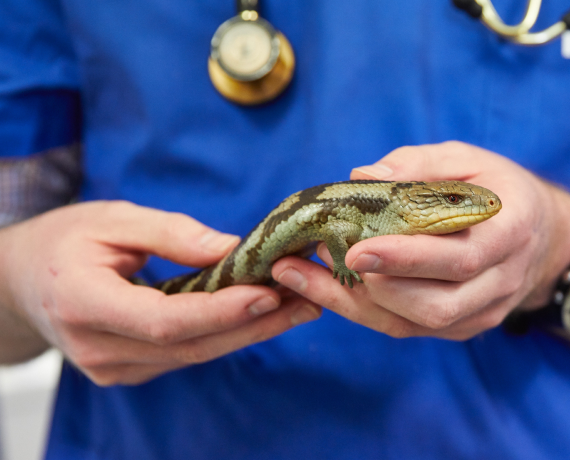
Reptile Emergencies
While some cases require urgent treatment, most after-hours concerns are best evaluated by our experienced team. Rather than going to an emergency clinic, the best thing for you and your pet is to come see our specialists at our next available appointment. If no appointments are available, we offer Emergency Admission Monday-Saturday beginning at 8am.
Signs your reptile may need veterinary care: diarrhea, vomiting, decreased appetite or not eating, egg-laying or prolonged straining, not passing stool for 4+ days, keeping eyes closed, weakness or inability to grasp/climb normally, unresponsive behavior, open-mouth breathing, shaking or twitching, or blood in stool.
Book next available appointment
Signs your reptile may need emergency after-hours veterinary care: most reptile concerns can and should wait to see a specialist, except in cases of major trauma, uncontrollable bleeding, or unconsciousness.
Basic First Aid Tips to Stabilize Your Reptile Before ER Transport
Stabilizing your reptile before taking them to the ER can prevent further stress and harm. Here are our recommendations: if your reptile is cold to the touch, increase the temperature to 85-90 degrees with a heat lamp, space heater or heating pad set on low, and monitor the temperature near your pet with a thermometer. If your reptile is weak and not eating but warm, minimize handling. If your reptile has a prolapse (something hanging out of vent or rear) keep exposed tissues moist with sterile saline contact lens solution or sterile water-based lubricant (i.e. KY jelly) and place your pet on moist paper towels. If your reptile is paralyzed, confine them to a small enclosure and do not handle them.
Recommended After-Hours Emergency Vets
Please be aware that after-hours appointments are more costly than daytime appointments, and ER vets specialize in the care of dogs and cats. Therefore, the level of care they are able to provide may not be optimal for your exotic pet. However, when it comes to the urgent situations noted above, they can provide the supportive care needed until your pet can be transferred to our hospital.
- VEG Mount Pleasant — 2183 N Hwy 17, Mt Pleasant, SC 29466 — (843) 879-4280
- BluePearl Pet Hospital – Mount Pleasant — 985 Johnnie Dodds Blvd, Mount Pleasant, SC 29464 — 843-216-7554
- BluePearl Pet Hospital – Summerville — 319 E 3rd N St, Summerville, SC 29483 — 843-216-7554
- Charleston Veterinary Referral Center — 3484 Shelby Ray Ct, Charleston, SC 29414 — 843-614-8387
Wildlife Emergencies
If you find an injured or orphaned wild animal outdoors, please contact one of the following, or reach out to one of the emergency vets listed above if found after hours.
- Keeper of the Wild
- Pet Vet — (843) 884-7387
- Dorchester Vet — (843) 552-0259